

Mobile apps for iOS and Android
Native-quality apps on both platforms, from user experience and accounts to App Store and Google Play release.
We design and build apps for businesses, schools and organisations in Thailand — from the problem worth solving to the day real users arrive — with the same team that builds and runs AIVEQ and TUXA on the App Store and Google Play.
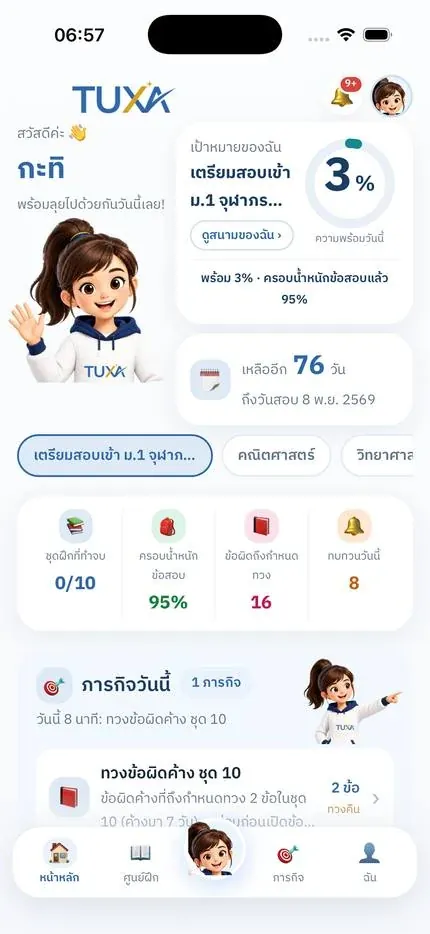
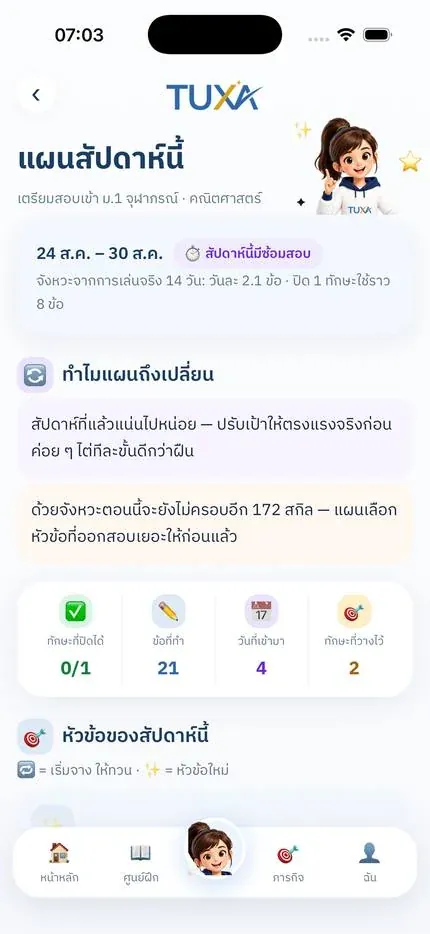
Real screens from TUXA, an app our team builds and runs
We don't start from a feature list. We start by asking who will use it, what for, and what outcome it should change — then decide what to build, and what not to.
Native-quality apps on both platforms, from user experience and accounts to App Store and Google Play release.
Browser-based systems that work on desktop, tablet and phone, with admin screens, user roles and a database.
Online learning, question banks, assessment and adaptive practice — our strongest area, because we have built it for ourselves.
Reports for teachers, leaders, parents and teams that answer real questions, not just look good.
Before building apps for anyone else, we built and ran our own apps with real users. Download them and try them — both are published under the developer name IQX COMPANY LIMITED.

AI-powered maths and science practice for Thai grades 4–7 that adjusts to each learner, with a view for parents.
See the product
An exam-prep navigator for Thai grade-7 entrance exams that reads how a child answers, then plans practice around where points are really lost.
See the productIf you are deciding who should build your app, these are the questions we would ask any company — including us. Clear answers tell you more than the lowest price.
A team that has run an app with real users knows what breaks after launch, not just how to build. Ask for the links and try them yourself.
A quote built only from a feature list usually misses the work users do every day, which then returns as change requests.
At AI.ac.thOur first step is talking to the people who will use the system, not only the people commissioning it — and we don't take work where we may not.
A team that accepts every feature request inflates the budget, stretches the timeline and makes the app harder to use.
At AI.ac.thEvery brief we deliver includes a list of what we recommend not building, with the reasons.
What users say when they see the real thing is always different from what they say about a picture. The later you see it, the more a change costs.
At AI.ac.thWe ship in rounds you can try before it is finished, and change it based on what real users tell us.
Launch day is when real problems start to appear. A team that disappears after handover leaves the burden with you.
At AI.ac.thWe follow real usage in the first weeks, fix what gets in the way, hand over an administrator guide and propose the next round from usage data.
If the documents and plans only work with one team, you cannot change teams even when you are unhappy.
At AI.ac.thDocuments from the Discovery Sprint are written so another team can build from them. No lock-in.
Not because we are picky — we do this kind of work badly, and other teams do it better.
Tell us the problem you are facing and we will answer these questions for your project directly. No spec needed.
Our work runs in four steps, each with a clear deliverable, so you always know where the project stands and what you already have.
We talk to the people who will actually use the system, not just the people commissioning it, map the current process end to end, and separate the real problem from its symptoms.
We design the data structure, access rights and key screens, starting from the tasks users do most often — not the prettiest screen.
We ship in rounds you can try before it is finished, because what users say when they see the real thing is always different from what they say about a picture.
Launch day is not the end. We follow real usage in the first weeks, fix what gets in the way, and decide what to build next from what the data shows.
Step one of every app project, available on its own.
Not ready to commit to the whole project? Start with step one alone. At the end you will know what to build, what it should cost and how long it will take.
Talk about a Discovery SprintWhat people ask before hiring an app developer
Choose a team that can answer the six questions before you hire clearly: do they have their own apps you can download, will they talk to real users before quoting, will they tell you what not to build, can you try the real thing in rounds, who looks after the app after launch, and can another team take the work over. If you want to start with us, a 2-week Discovery Sprint gives you a prototype, a budget estimate and a plan before you commit to the whole project.
We are a Thai team that builds and runs its own apps — AIVEQ and TUXA, both on the App Store and Google Play. The same team builds systems for schools, businesses and organisations and teaches AI-assisted development through AI Academy, so we design for the day real users arrive, not just for handover day.
It depends on scope, the number of users and the systems it must connect to. If you are not sure how big your project is, start with a 2-week Discovery Sprint: you finish with a budget and timeline estimate you can rely on before committing to the whole project. For typical market ranges in Thailand, see our guide to app development costs (in Thai).
That also depends on scope. What we can say for certain is that the first step takes two weeks (the Discovery Sprint), and it produces a development plan in rounds with a timeline for the whole project. During development you try the work in rounds instead of waiting for the end.
Yes. Our own apps, AIVEQ and TUXA, are available on both the App Store and Google Play. If your project suits a web app better, we will say so — not every project needs to be a mobile app.
Yes, and that is how we prefer to start. Tell us the problem you are facing; our first step is to talk to the people who will use the system and write the brief for you.
Yes. The documents are written so another team can build from them. There is no lock-in.
Yes. Launch day is not the end: we follow real usage in the first weeks, fix what gets in the way, hand over an administrator guide and propose the next round based on usage data.
Yes, and it is what we know best, because our own products are learning systems: online learning, question banks, assessment, adaptive practice and reporting for teachers, school leaders and parents.
Work that only wants code typed to a finished spec with no questions allowed, work where we may not speak to a single real user, and work that measures success by features delivered rather than what changes for users. Not because we are picky — we do this kind of work badly, and other teams do it better.
No spec needed. Tell us the problem you are facing and we will help you see where to start — or whether you need to build anything new at all.